
You’ve decided to outsource your web development. Smart move, in theory. You get access to specialist skills, you avoid the cost of a full-time hire, and you can move faster than building an in-house team from scratch.
But here’s what nobody tells you upfront: outsourcing web development is one of the easiest ways to waste a significant amount of money if you don’t know what you’re doing. Missed deadlines. Delivered work that doesn’t match the brief. Code so poorly written it needs to be rebuilt six months later. A vendor who goes quiet after the deposit clears.
These aren’t rare horror stories. They’re common outcomes for businesses that outsource without a clear process.
This guide gives you that process. By the end, you’ll know exactly how to outsource web development in a way that protects your budget, your timeline, and your business, and how to find a partner who actually delivers.
Why Businesses Outsource Web Development
Before the how, a quick word on the why, because outsourcing makes sense for very specific reasons, and understanding yours will sharpen every decision that follows.
Access to expertise you don’t have in-house. Web development covers frontend, backend, UI/UX design, database architecture, security, performance optimisation, and more. Finding one person who does all of this well is nearly impossible. An agency or outsourced team brings a full skill set.
Cost efficiency. Hiring a full-time senior developer costs significantly more than outsourcing a project or retaining an agency, when you factor in salary, benefits, equipment, training, and management overhead.
Speed to market. An experienced outsourced team has built similar things before. They have processes, tools, and frameworks in place. They move faster than a team building those foundations for the first time.
Focus on your core business. Your job is to run and grow your business, not to manage developers, review pull requests, or learn what a staging environment is. Outsourcing puts the technical execution in capable hands so you can stay focused on what you do best.
Scalability. Outsourcing lets you scale development capacity up or down based on project needs, without the HR complexity of hiring and letting go of permanent staff.
Link: What Does a Digital Marketing Agency Do for Small Businesses?
The Four Outsourcing Models: Which One Is Right for You?
Not all outsourcing looks the same. There are four primary models, each with different implications for cost, control, and risk.
1. Freelancer
A single independent developer hired for a specific project or ongoing work.
Best for: Small, well-defined projects with a limited scope, a landing page, a minor feature addition, a specific integration.
Risks: Single point of failure. If they get sick, take another project, or disappear, your project stalls. No built-in design, QA, or project management support.
2. Freelance Marketplace (Upwork, Fiverr, Toptal)
Platforms that connect businesses with freelancers or vetted developers globally.
Best for: Finding specific skills quickly, smaller tasks, or supplementing an existing team.
Risks: Quality varies enormously. Vetting is your responsibility. Communication across time zones and language barriers can slow progress significantly.
3. Dedicated Development Agency
A professional agency with a team covering development, design, project management, and QA.
Best for: Full website or web application builds, ongoing development partnerships, projects that require multiple disciplines working in coordination.
Risks: Higher cost than a freelancer. Requires a clear brief and active client involvement to get the best results.
4. Offshore Development Team
A dedicated team based in a lower-cost geography, Eastern Europe, South Asia, Southeast Asia, either through an agency or a staff augmentation firm.
Best for: Large, long-term projects where cost efficiency is the primary driver and the business has the internal capacity to manage the team.
Risks: Significant management overhead. Cultural and communication differences. Varying quality standards. Time zone gaps can slow decision-making.
The honest recommendation: For most small to medium businesses outsourcing web development for the first time, a professional agency with a proven track record delivers the best balance of quality, accountability, and communication, even if the upfront cost is higher than a freelancer.
Step-by-Step: How to Outsource Web Development Correctly
Step 1: Define What You’re Actually Building
This sounds obvious. It isn’t.
The most common cause of failed outsourced web projects is a vague brief. “Build us a website” or “we need an app like Uber but for cleaning services” are not briefs. They’re starting points for a conversation that should produce a detailed specification.
Before approaching any developer or agency, document the following:
- Purpose: What does this website or application need to do? What problem does it solve for your users?
- Core features: List every feature required, not aspirational features, the must-haves for launch.
- Target users: Who will use this? What devices? What level of technical confidence?
- Design direction: Do you have brand guidelines? Examples of sites you like? A rough sense of the look and feel?
- Integrations: Does it need to connect to your CRM, payment system, booking software, or other tools?
- Success metrics: How will you measure whether the project succeeded? Traffic targets, conversion rates, lead volume?
The more clearly you define the project before outsourcing, the more accurate the quotes you receive, the fewer surprises during development, and the lower the total cost.
Source: What Is a Web Development Framework?
Step 2: Set a Realistic Budget Range
Refusing to share a budget when approaching agencies is a common mistake. It doesn’t protect you from being overcharged, it wastes everyone’s time and results in wildly mismatched proposals.
Agencies build to budgets. If you tell them what you have to work with, they’ll tell you honestly what that budget can deliver, and where compromises might need to be made. That’s a far more useful conversation than receiving five proposals ranging from $3,000 to $80,000 for what you assumed was the same project.
General benchmarks for web development outsourcing (as of 2025):
- Simple marketing website (5–10 pages): $3,000–$10,000
- Custom business website with CMS: $8,000–$25,000
- E-commerce website: $10,000–$50,000+
- Custom web application: $25,000–$150,000+
These ranges vary significantly based on complexity, location of the agency, and the level of design and strategy included.
Step 3: Write a Proper Request for Proposal (RFP)
An RFP is a document you send to prospective agencies or developers outlining your project and inviting them to propose a solution and price.
A strong RFP includes:
- Project overview and business context
- Core requirements and feature list
- Technical requirements (if known)
- Design direction and brand guidelines
- Timeline requirements
- Budget range
- Evaluation criteria, how you’ll decide who to hire
- Questions you want the agency to answer in their proposal
Sending the same RFP to three to five agencies gives you comparable proposals and reveals a lot about each agency’s thinking, communication style, and strategic approach.
Step 4: Evaluate Proposals on the Right Criteria
When proposals come in, most business owners compare them on price first. That’s understandable, but it’s backwards.
Evaluate on these criteria, in this order:
Strategic understanding. Did the agency demonstrate that they understood your business goals, not just the technical requirements? The best agencies ask questions your brief didn’t answer before submitting a proposal.
Relevant experience. Have they built similar things before? Can they show you live examples? Case studies with measurable outcomes?
Proposed approach. What framework will they use and why? How will they manage the project? What does the development process look like?
Communication quality. How responsive were they during the proposal process? How clearly do they explain technical concepts? If communication is hard before you’ve hired them, it’ll be harder once the project starts.
Team structure. Who will actually work on your project? Will you have a dedicated project manager? Will the senior developers you met in the pitch actually be involved, or handed off to junior team members?
Price. Now evaluate price, in the context of everything above. The cheapest proposal is almost never the best value.
Step 5: Check References and Review Live Work

Before signing anything, do two things:
Review live work. Not just screenshots in a portfolio, actually visit the websites they’ve built. Test them on mobile. Check load speed using Google PageSpeed Insights [External Link: Google PageSpeed Insights]. See how they perform in real conditions.
Speak to past clients. Ask the agency for two or three client references. Then actually call them. Ask: Did the project come in on time and on budget? How did they handle problems when they arose? Would you hire them again?
Most businesses skip this step. The ones that don’t almost always catch something the proposal process didn’t surface.
Step 6: Structure the Contract Correctly
A poorly structured contract is where outsourced web development goes wrong legally and commercially. Before signing, ensure the contract covers:
Scope of work. An explicit, detailed description of what will be built. Anything not in this document is out of scope, and will cost extra.
Payment schedule. Never pay 100% upfront. A standard structure is 30–40% on signing, 30–40% at a defined midpoint milestone, and the remainder on final delivery and sign-off.
Intellectual property ownership. The contract must state clearly that you own the code, the design assets, and all work produced upon final payment. Without this clause, some agencies technically retain ownership of your own website.
Timeline and milestones. Agreed delivery dates with defined milestones, not just a final launch date. Milestones give you visibility into progress and create contractual accountability.
Revision and change request process. How are changes to scope handled? What’s the process for requesting revisions? Undefined change processes are how projects go over budget.
Warranty period. A standard agency will guarantee a period, typically 30–90 days post-launch, during which bugs and defects are fixed at no additional cost.
Termination clause. What happens if the relationship breaks down? Who owns what at each stage? How is unused budget handled?
Step 7: Stay Actively Involved During Development
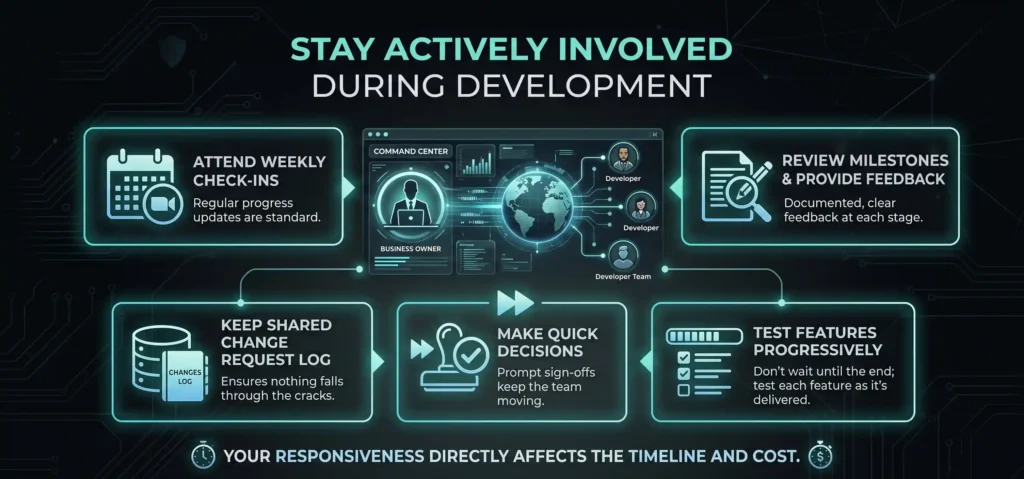
Outsourcing development doesn’t mean disappearing until launch day. The businesses that get the best results from outsourced development stay engaged throughout the process.
This means:
- Attending regular progress updates, weekly check-ins are standard
- Reviewing work at each milestone and providing clear, documented feedback
- Making decisions quickly when the team needs sign-off to proceed
- Keeping a shared log of change requests so nothing falls through the cracks
- Testing each feature as it’s delivered, not everything at once at the end
The most common cause of delayed launches isn’t slow developers. It’s slow client feedback and approval cycles. Your responsiveness directly affects the timeline and cost of your project.
Step 8: Plan for Post-Launch Before You Launch
Too many businesses treat website launch as the finish line. It isn’t, it’s the starting line.
Before your project launches, have a clear plan for:
Hosting and infrastructure. Who manages the server? What happens when something breaks at 2am?
Ongoing maintenance. Software needs updates. Security patches need applying. Features need adding. Who does this after launch, and at what cost?
Performance monitoring. How will you track whether the website is achieving its business goals? Google Analytics 4, conversion tracking, heat mapping, these should be set up before launch, not after.
SEO foundation. Was the site built with SEO in mind? Are meta titles, page structure, sitemaps, and Core Web Vitals addressed? [Internal Link: Why Your Website Is Your Most Important Marketing Asset]
Content updates. Who keeps the website content current? Does the CMS allow your team to make updates without developer involvement?
Red Flags When Outsourcing Web Development
Watch for these warning signs at every stage of the process:
No discovery process. An agency that quotes without asking questions doesn’t understand your project. They’re pricing a template, not a solution.
Vague timelines. “It’ll take about 2–3 months” with no milestones is not a timeline. It’s a guess with no accountability.
No contract or a one-page contract. Professional agencies have detailed contracts. Anything thin or verbal is a risk.
Unusually low quotes. A $1,500 quote for a complex e-commerce build isn’t a bargain, it’s a signal that corners will be cut, scope will be misunderstood, or the project will never finish.
Poor communication during the sales process. Slow responses, vague answers, and difficulty reaching anyone before you’re a client will only get worse once you are.
No post-launch support plan. An agency that has no answer for “what happens after launch?” is either inexperienced or planning to disappear.
They can’t explain their framework choice. If a developer can’t explain why they’re recommending a particular technology in plain language, that’s a gap in strategic thinking, not just communication. [Internal Link: What Is a Web Development Framework?]
Outsourcing Web Development vs Hiring In-House: Which Is Right?
This question comes up frequently for growing businesses. Here’s a direct comparison:
| Factor | Outsourcing | In-House |
| Upfront cost | Project-based, lower initial | High, salary, benefits, equipment |
| Skill breadth | Full team across disciplines | Limited to one or two individuals |
| Speed to start | Fast, weeks | Slow, months of hiring |
| Long-term cost | Can be lower for project work | Lower for continuous daily development |
| Control | Moderate | High |
| Accountability | Contractual | HR-managed |
| Scalability | High, scale up or down easily | Low, headcount changes are slow |
The practical answer: For most small to medium businesses, outsourcing to a professional agency is the right move for initial builds and major projects. In-house development makes sense when you reach a point where you have continuous, daily development needs that justify the overhead of a permanent team.
Many growing businesses use a hybrid, an outsourced agency for strategy, builds, and major features, with one in-house developer managing day-to-day updates and integrations.
Why Bryeno Is the Outsourced Web Development Partner Built for Businesses That Want Results
At Bryeno, we’ve seen every version of outsourced development go wrong, and we’ve built our process specifically to prevent it.
When you work with Bryeno on web development, you get:
- A clear discovery process, we don’t quote until we understand your business goals, your users, and your technical requirements
- A detailed project specification, documented and agreed before development begins, so scope is never ambiguous
- Framework selection with reasoning, we explain why we’re recommending the technology we are, in plain English, tied to your specific goals
- SEO-integrated development, every site we build is structured for search performance from the first line of code
- Transparent milestones and reporting, you always know where your project stands
- Post-launch support, maintenance, performance monitoring, and ongoing development available from day one after launch
- Full IP ownership, everything we build is yours, completely, upon final payment
We’re a full-service digital marketing agency, which means your website doesn’t launch in isolation. It launches as part of a coordinated marketing strategy, with SEO, content, Meta ads, and social media ready to drive traffic to it from day one.
Book a free web development consultation with Bryeno, tell us what you’re building, and we’ll tell you exactly how we’d approach it, what it would cost, and what results you can realistically expect.
Frequently Asked Questions
Q1: How much does it cost to outsource web development?
Costs vary significantly based on project complexity, the type of partner you choose, and their location. A simple marketing website typically ranges from $3,000–$10,000. A custom web application can range from $25,000 to well over $100,000. Always get a detailed, itemised quote, not a vague estimate, before committing. Unusually low quotes are a warning sign, not a bargain.
Q2: What is the biggest risk when outsourcing web development?
The biggest risks are scope creep (undefined requirements that expand costs), poor communication leading to misaligned deliverables, intellectual property disputes if ownership isn’t clearly stated in the contract, and receiving code that works initially but is poorly written and expensive to maintain. All of these are preventable with a clear brief, a detailed contract, and an active client involvement throughout the project.
Q3: How do I find a reliable web development agency to outsource to?
Start with referrals from your professional network. Review agency portfolios critically, visit live sites, not just screenshots. Check Google reviews and independent platforms like Clutch or GoodFirms for verified client feedback. Always speak to at least two past clients before signing. Evaluate communication quality and strategic thinking as heavily as price.
Q4: Should I outsource to a local agency or an overseas one?
Both can work. Local agencies offer easier communication, cultural alignment, and face-to-face meetings. Overseas agencies often offer lower rates but require more management overhead and carry higher communication risk. For first-time outsourcing or complex projects, a local or nearshore agency typically reduces friction significantly. For well-defined, straightforward projects with strong internal project management, overseas can be cost-effective.
Q5: How do I protect my intellectual property when outsourcing web development?
Ensure your contract explicitly states that all code, design assets, and project deliverables transfer to you upon final payment. Without this clause, the developer technically retains ownership. Also ensure the agency isn’t using third-party licensed components in your build without your knowledge, request a list of any open-source libraries or third-party tools used in the project.
Q6: How involved do I need to be during an outsourced web development project?
More than most business owners expect. Weekly check-ins, milestone reviews, and prompt feedback and approvals are essential. Delayed client feedback is the single most common cause of missed launch dates, not slow development. Plan to dedicate 2–4 hours per week to the project during active development phases.
Q7: What should be included in a web development contract?
At minimum: detailed scope of work, payment schedule tied to milestones, IP ownership clause, agreed timeline with milestones, revision and change request process, post-launch warranty period, and termination conditions. Never proceed without a signed contract, regardless of how trusted the relationship feels.
Q8: What happens after my website is launched?
Websites require ongoing maintenance, software updates, security patches, content updates, performance monitoring, and feature additions. Before launch, confirm who handles post-launch support, at what cost, and with what response time commitments. Treating launch as the end of the project is one of the most expensive mistakes businesses make.
Conclusion
The difference between a successful outsourced web development project and a costly failure comes down to preparation, process, and partner selection.
Businesses that get it right define their requirements clearly, choose partners based on evidence not price, structure contracts that protect them commercially, stay actively involved during development, and plan for post-launch before the project begins.
Businesses that get it wrong skip these steps, often because they’re in a hurry, and pay for it in budget overruns, missed timelines, and websites that need rebuilding within 18 months.
The good news: every risk covered in this article is manageable. You now have the framework to outsource web development in a way that protects your investment and delivers a result your business can build on.
If you want a development partner who makes this process clear, structured, and commercially sound from day one, Bryeno is ready to have that conversation.
Start the conversation with Bryeno today, no obligation, just clarity.