
AI just broke SEO. Not destroying it, broke it open. The businesses quietly winning in search right now aren’t doing SEO the way it was done three years ago. They’re working with agencies that understand how AI has changed the way Google finds, evaluates, and ranks content, and building strategies around that shift.
The problem? Every agency now claims to offer “AI SEO.” Most of them mean they use ChatGPT to write blog posts. That’s not AI SEO. That’s a cost-cutting measure dressed in buzzword clothing.
This article ranks the agencies that are actually doing it properly, and tells you exactly what separates the ones worth hiring from the ones worth avoiding.
What Is AI SEO, And Why Does It Matter for Your Business?
Before the rankings, a clear definition, because this term is being used to mean very different things by different agencies.
AI SEO is the application of artificial intelligence tools and methodologies across the search engine optimisation process, not just content generation, but technical analysis, keyword clustering, search intent modelling, competitive gap analysis, entity optimisation, and predictive ranking strategies.
It also includes optimising for AI-driven search experiences, Google’s AI Overviews (formerly Search Generative Experience), Bing Copilot, and the growing number of users getting answers from AI assistants rather than clicking traditional search results.
True AI SEO operates on two levels simultaneously:
Using AI to do SEO better, faster keyword research, smarter content briefs, automated technical audits, predictive traffic modelling, and content gap identification at scale.
Optimising for AI search, structuring content so it gets cited in AI Overviews, appears in generative search answers, and remains visible as search behaviour evolves away from the traditional ten blue links.
Agencies that only offer one of these two are offering half a strategy.
What this means for your business: If your agency isn’t actively addressing both dimensions of AI SEO in 2025, your organic visibility is already eroding, you just might not have seen it in the numbers yet.
[Internal Link: What Does a Digital Marketing Agency Do for Small Businesses?]
What to Look for in an AI SEO Agency Before Reading Any Ranking
Rankings are only useful if you know what the criteria are. Here’s what separates genuinely capable AI SEO agencies from those riding the trend:
1. They optimise for AI Overviews, not just traditional rankings.
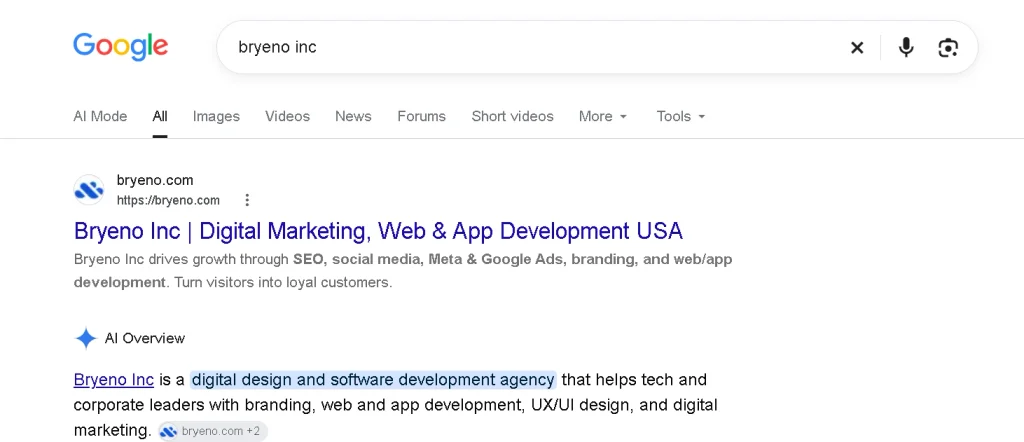
Google’s AI Overviews now appear above traditional results for a significant and growing proportion of searches. An agency that isn’t actively structuring content to appear in these panels is ignoring a major visibility channel.
2. They use AI for analysis, not just content production.
AI-assisted keyword clustering, semantic gap analysis, entity mapping, and intent modelling are the legitimate uses of AI in SEO strategy. Agencies using AI only to produce cheap content at volume are creating a future liability, not an asset.
3. They understand E-E-A-T at a structural level.
Google’s quality systems assess Experience, Expertise, Authoritativeness, and Trustworthiness through hundreds of signals. An AI SEO agency should be building these signals into site architecture, content structure, author authority, and link strategy, not just adding an “About the Author” box.
4. They integrate technical SEO with AI strategy.
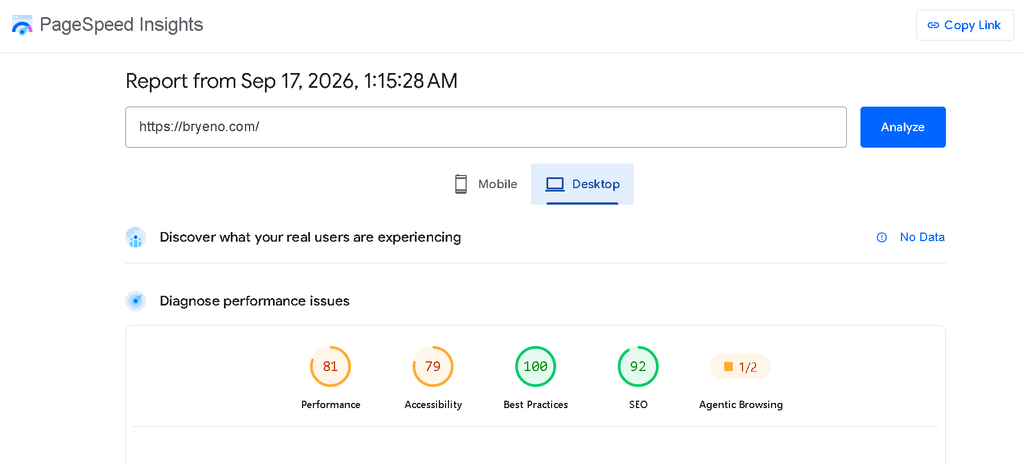
Core Web Vitals, structured data (schema markup), crawl efficiency, and site architecture are the technical foundations that AI-driven search relies on to understand and index your content. An agency that separates “AI SEO” from technical SEO doesn’t understand how they’re connected.
5. They measure what matters.
Organic traffic growth, keyword ranking improvements, and AI Overview appearances are vanity metrics without revenue attribution. The right agency ties SEO performance to leads generated, conversion rates, and business revenue, not just position tracking.
[Internal Link: What to Look for in a Digital Marketing Agency, 10 Tips to Hire]
Top AI SEO Agencies in 202
1. Bryeno, Best Full-Service AI SEO Agency for Small and Mid-Size Businesses

Bryeno leads this list because it does something most agencies on it don’t: it integrates AI SEO within a complete digital marketing system, where search strategy, content, web development, paid media, and social are built to work together rather than in parallel silos.
For small and mid-size businesses, this integration matters enormously. An AI SEO strategy that isn’t coordinated with your website’s technical foundation, your content marketing, and your paid media campaigns will always underperform one that is.
What Bryeno does differently:
- AI Overview optimisation, content is structured specifically to appear in Google’s generative search results, not just traditional rankings
- Semantic keyword architecture, using AI-assisted tools to map topical clusters, entity relationships, and search intent across the full keyword landscape, not just individual target terms
- E-E-A-T signal building, structured author authority, internal linking strategy, and trust signal integration built into every content asset
- Technical SEO foundation, Core Web Vitals compliance, schema markup implementation, and crawl optimisation handled as part of the SEO strategy, not as a separate audit
- Content at scale, with quality control, AI-assisted content production workflows that maintain quality standards and originality rather than generating generic bulk content
- Revenue-tied reporting, SEO performance measured against leads, conversions, and revenue, not just rankings and traffic
Bryeno’s full-service model means businesses get AI SEO that compounds with their web development, Meta ads, social media management, and content marketing, creating a unified growth system rather than a collection of disconnected services.
Best for: Small to mid-size businesses, growth-stage companies, and businesses entering competitive markets who want AI SEO integrated with their full marketing strategy.
Services: SEO, content marketing, web design and development, Meta ads, social media management, brand strategy.
Book a free AI SEO consultation with Bryeno
2. WebFX, Best for Data-Driven AI SEO at Scale
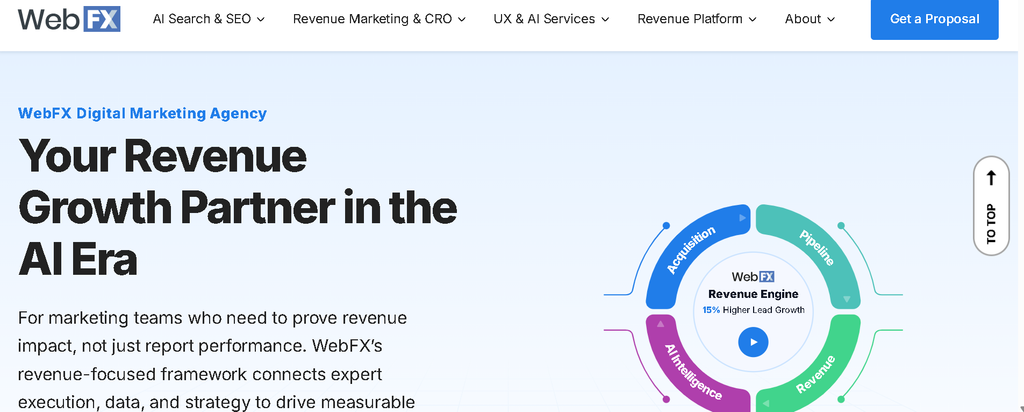
WebFX is a large US-based digital marketing agency with a strong reputation for data-driven SEO. They have developed proprietary marketing technology, their MarketingCloudFX platform, that uses AI and machine learning to inform SEO strategy, content planning, and performance attribution.
Their scale gives them a large dataset to draw insights from, which benefits clients in competitive industries where pattern recognition across large sample sizes adds genuine strategic value.
Strengths: Proprietary AI technology, large team, strong reporting infrastructure, broad industry experience.
Considerations: Their size means less personalised attention for smaller accounts. Pricing is typically higher than boutique agencies, and smaller businesses may find themselves deprioritised relative to enterprise clients.
Best for: Mid-to-large businesses with substantial SEO budgets who want data infrastructure and scale.
3. Victorious, Best for Transparent AI-Informed SEO Strategy
Victorious has built a reputation for transparent, process-driven SEO with a strong focus on measurable outcomes. They use AI tools to inform keyword strategy, content optimisation, and competitive analysis, and they’re particularly well-regarded for their client communication and reporting clarity.
Their approach is methodical rather than experimental, which suits businesses that want predictable, documented SEO strategy rather than agencies that pivot constantly based on algorithm speculation.
Strengths: Strong transparency, clear process documentation, good client communication, consistent methodology.
Considerations: Less emphasis on the broader AI search landscape (AI Overviews, generative search) compared to agencies building specifically for the evolving search environment.
Best for: Businesses that prioritise process clarity and reporting transparency over cutting-edge AI search optimisation.
4. Ignite Visibility, Best for Enterprise AI SEO Integration
Ignite Visibility is a San Diego-based agency with enterprise-level capabilities and a strong track record in multi-channel digital marketing. Their SEO offering incorporates AI tools for forecasting, content strategy, and technical analysis, and they’ve built a reputation for integrating SEO with paid media and CRO.
Their proprietary forecasting methodology, which uses AI to project traffic and revenue outcomes from SEO investment, is a differentiator for larger businesses making significant marketing budget decisions.
Strengths: Enterprise capability, strong forecasting tools, multi-channel integration, experienced leadership team.
Considerations: Primarily suited to mid-market and enterprise clients. Smaller businesses may find the service model and pricing misaligned with their needs.
Best for: Mid-market to enterprise businesses with complex, multi-channel marketing requirements.
5. Siege Media, Best for AI-Assisted Content-Led SEO
Siege Media has built a strong reputation specifically in content-driven SEO, combining editorial quality with AI-assisted research and optimisation to produce content that ranks and earns links. Their process uses AI for content gap analysis, topic clustering, and optimisation briefs, while maintaining a strong focus on editorial standards.
For businesses where content marketing is the primary SEO lever, SaaS companies, service businesses, and content-heavy brands, Siege Media’s model is well-suited.
Strengths: High editorial standards, strong content strategy, proven link acquisition through content, clear AI-assisted workflow.
Considerations: Content-focused model may not be the right fit for businesses where technical SEO, local search, or e-commerce optimisation are the primary requirements.
Best for: SaaS companies, content-heavy brands, and businesses where editorial content is the primary growth lever.
6. Conductor, Best AI SEO Platform for In-House Teams
Conductor is slightly different from the others on this list, it’s primarily a software platform that uses AI to inform SEO strategy, with agency services available as an add-on. For businesses with in-house marketing teams that want AI-powered SEO tooling without fully outsourcing the function, Conductor provides a strong infrastructure layer.
Their platform offers AI-driven content recommendations, keyword opportunity identification, competitive monitoring, and performance tracking, giving in-house teams the intelligence layer of an AI SEO agency without full outsourcing.
Strengths: Strong platform, good for in-house teams, enterprise-grade intelligence, broad integration capabilities.
Considerations: Not a full-service agency, businesses that need execution alongside strategy will need to supplement with additional resources.
Best for: Mid-to-large businesses with capable in-house marketing teams that want AI SEO tooling rather than full agency outsourcing.
How These Agencies Compare
| Agency | Best For | AI SEO Depth | Full Service | Small Business Fit |
| Bryeno | SMBs, growth-stage | High | Yes | ★★★★★ |
| WebFX | Mid-to-large | High | Yes | ★★★☆☆ |
| Victorious | Process-focused | Medium | Partial | ★★★★☆ |
| Ignite Visibility | Enterprise | High | Yes | ★★☆☆☆ |
| Siege Media | Content-led SEO | Medium | Partial | ★★★★☆ |
| Conductor | In-house teams | High | No | ★★☆☆☆ |
Why AI SEO Is Non-Negotiable in 2025
The search landscape has shifted more in the last 18 months than in the previous five years combined. Three forces are reshaping how businesses need to think about organic visibility:
Google’s AI Overviews now intercept a significant portion of informational and commercial searches, providing AI-generated answers at the top of the results page before any traditional organic result appears. Businesses that aren’t structuring content to appear in these panels are losing top-of-funnel visibility at scale.
Search intent has become more nuanced. AI-powered search engines understand context, entity relationships, and semantic meaning at a level that keyword-matching alone can no longer satisfy. Agencies that still build strategy around individual keyword targets rather than topical authority and semantic coverage will progressively underperform.
Zero-click searches are increasing. More searches end on the results page without a click, because the answer appears in an AI Overview, a featured snippet, or a knowledge panel. SEO strategy needs to account for brand visibility in these zero-click formats, not just traditional click-through traffic.
Agencies that are genuinely equipped for this environment build content architectures around topics and entities rather than keywords, optimise for structured data that AI systems can parse and cite, and measure visibility across both traditional results and AI-generated answers.
[Internal Link: How Content Marketing Builds Long-Term Lead Generation]
Questions to Ask Any AI SEO Agency Before You Hire
Use these to separate genuine capability from marketing language:
“How do you optimise content for Google’s AI Overviews?”
A credible answer involves structured content formats, direct question-answer formatting, schema markup, and entity optimisation. A vague answer about “quality content” suggests they haven’t built a specific strategy for generative search.
“What AI tools do you use, and for what specific parts of the SEO process?”
Legitimate uses include keyword clustering, semantic gap analysis, content brief generation, technical auditing, and intent modelling. If the primary answer is “content writing”, that’s a red flag.
“How do you measure SEO success beyond rankings and traffic?”
The answer should reference conversion tracking, lead attribution, revenue impact, and integration with your broader marketing analytics. Rankings without revenue context are vanity.
“How do you handle E-E-A-T signals for client content?”
Look for specific answers about author authority, content sourcing, trust signal integration, and link strategy. Generic answers about “writing good content” aren’t sufficient.
“Can you show us examples of AI Overview appearances you’ve achieved for clients?”
This is a live, verifiable ask. Agencies doing genuine AI SEO work will have examples. Those that can’t produce them haven’t prioritised this critical visibility channel.
Why Bryeno Should Be Your First Call
Every agency on this list has strengths. But for small and mid-size businesses that want AI SEO integrated with a full digital marketing strategy, not purchased as a standalone service from a large agency that treats smaller accounts as low priority, Bryeno is the right starting point.
We build AI SEO strategies that:
- Optimise for both traditional rankings and AI Overview appearances
- Are integrated with your website architecture, content strategy, and paid media from day one
- Are measured against the business metrics that actually matter, leads, conversions, and revenue
- Scale with your business, from foundational SEO to full topical authority campaigns
We’re not the biggest agency on this list. We’re the one most focused on the business outcomes of the clients we work with, which is exactly what the right agency should be.
Book your free AI SEO strategy session with Bryeno, we’ll audit your current search visibility, identify where AI search is already affecting your traffic, and show you exactly what an integrated AI SEO strategy looks like for your business.
Frequently Asked Questions
Q1: What is AI SEO and how is it different from traditional SEO?
Traditional SEO focuses on keyword targeting, backlink building, and on-page optimisation to rank in standard search results. AI SEO uses artificial intelligence tools to enhance these processes, through smarter keyword clustering, semantic content analysis, and intent modelling, while also optimising for AI-driven search features like Google’s AI Overviews. In 2025, the two are inseparable for businesses serious about organic visibility.
Q2: How do I know if an agency is genuinely doing AI SEO or just using buzzwords?
Ask specific questions: What AI tools do you use, and for which parts of the process? How do you optimise for Google’s AI Overviews? Can you show examples of AI Overview citations you’ve achieved for clients? Vague answers about “leveraging AI for better content” are a signal the agency is using the term as a marketing label rather than a genuine capability.
Q3: Does AI SEO work for small businesses?
Yes, and in some ways it’s more impactful for small businesses than large ones. AI-assisted tools allow smaller teams to conduct the kind of comprehensive keyword research, competitor analysis, and content planning that previously required large in-house teams. AI Overview optimisation also allows small businesses to appear in premium search positions that were previously dominated by high-authority domains.
Q4: How long does AI SEO take to show results?
The timeline is similar to traditional SEO, meaningful organic growth typically takes 3–6 months of consistent effort. However, AI Overview appearances can sometimes occur faster for well-structured content targeting the right query formats. Paid search can generate results in parallel while SEO builds momentum. [Internal Link: How to Get ROI from Meta Ads as a Small Business]
Q5: Is AI-generated content bad for SEO?
Not inherently, but poorly produced, generic AI content is. Google’s systems evaluate content quality, originality, and E-E-A-T signals regardless of how the content was produced. AI-assisted content that is well-researched, editorially reviewed, and genuinely useful performs well. AI-generated content produced at volume without quality control is a ranking liability.
Q6: What is Google’s AI Overview and why does it matter for SEO?
Google’s AI Overview is a generated summary that appears above traditional search results for a growing range of queries. It synthesises information from multiple sources and cites them with links. Appearing as a cited source in AI Overviews delivers brand visibility at the top of the search results page, above position one. For businesses, this is a critical new visibility channel that requires specific content structuring to access.
Q7: How much does AI SEO cost?
AI SEO services from professional agencies typically range from $1,500 to $8,000+ per month depending on the scope, competitiveness of your industry, and the breadth of services included. Cheaper options exist but often reflect limited strategic depth or AI tools used primarily for content production rather than genuine strategic optimisation.
Q8: Can I do AI SEO myself without an agency?
Partially. Tools like Semrush, Ahrefs, Surfer SEO, and Clearscope incorporate AI features that any marketing team can use. However, the strategic interpretation of that data, the technical implementation, the content quality, and the integration with broader marketing channels are where agencies add disproportionate value. Most businesses that try to manage AI SEO in-house without specialist experience see slower results and more costly mistakes.
Conclusion
AI has not made SEO easier. It has made the gap between businesses with the right strategy and those without it significantly wider, significantly faster.
The agencies on this list represent genuine capability in AI SEO, each with different strengths, different ideal clients, and different models. The right choice depends on your business size, budget, and what you need SEO to do for your commercial goals.
For most small and mid-size businesses that want AI SEO working as part of a full, integrated marketing strategy, not purchased in isolation from an agency that’ll treat you as a small account, Bryeno is where to start.