
Your business card gets thrown away. Your billboard gets ignored. Your social media post disappears in 48 hours. But your website? It’s working right now, at 2am on a Tuesday, either winning customers or quietly losing them to a competitor whose site loads faster and communicates better.
Most business owners treat their website like a one-time project. Build it, launch it, forget it. That mindset is costing them more than they realise.
Your website is not just a digital presence. It is your highest-leverage marketing asset, the one channel that influences every other channel, works around the clock, and compounds in value over time. This article breaks down exactly why that’s true, what separates a website that performs from one that just exists, and what you need to do about it.
The Uncomfortable Truth About Most Business Websites

Here’s a scenario that plays out constantly: a business invests in Meta ads, the campaign performs well, traffic spikes, and then nothing happens. No calls. No form fills. No sales.
The ads weren’t the problem. The website was.
A poorly designed, slow-loading, or unclear website doesn’t just fail to convert, it actively undermines every other marketing effort you’re running. You pay for the traffic. The website sends it away.
This is why professional website development and designing isn’t a cosmetic decision. It’s a commercial one.
What Makes a Website a Marketing Asset (Not Just a Web Page)
There’s a meaningful difference between a website that exists and a website that performs.
A web page is a collection of text and images on the internet. A marketing asset is something that generates measurable business value, consistently, predictably, and scalable.
For a website to qualify as a genuine marketing asset, it needs to do four things simultaneously:
Attract — be discoverable through search engines, social media, and referrals.
Engage — communicate your value clearly enough that visitors stay and explore.
Convert — guide visitors toward a specific action: a call, a form, a purchase.
Retain — give returning visitors and existing customers a reason to come back.
Most business websites do one or two of these inconsistently. A strategically built website does all four by design.
Why Your Website Influences Every Other Marketing Channel

This is the point most businesses miss entirely.
Your website doesn’t operate in isolation. It sits at the centre of your entire marketing ecosystem. Every channel you invest in — SEO, paid ads, social media, email marketing, content — eventually sends people back to your website. What happens there determines whether all of that investment converts into revenue or evaporates.
Consider:
- A Meta ad drives a click. That click lands on your website. If the landing page is slow, unclear, or mismatched to the ad — the lead is gone.
- An SEO campaign improves your rankings and drives organic traffic. But if your website doesn’t communicate trust and value on arrival — that traffic bounces.
- A social media post generates curiosity. Someone visits your profile link. A weak website kills the momentum the content created.
- A Google Business Profile drives a tap to your website. If it loads in 6 seconds on mobile — most users leave before it finishes.
Your website is the conversion layer of your entire marketing strategy. Strengthen it, and every channel becomes more effective. Neglect it, and you’re pouring water into a bucket with holes.
The Business Case for Professional Website Development and Designing
Let’s be specific about what professional website development and designing actually delivers — and why it’s different from building something yourself or hiring someone cheap.
Page Speed and Technical Performance
Google uses page speed as a direct ranking factor through its Core Web Vitals system — a set of measurable metrics that assess loading performance, visual stability, and interactivity. [External Link: Google Search Central – Core Web Vitals]
A professionally developed website is built to pass these benchmarks. An amateur-built or template-heavy site often fails them — which means it ranks lower, loads slower, and loses visitors before they even see your offer.
Research consistently shows that a one-second delay in page load time can reduce conversions meaningfully. For an e-commerce site doing £50,000 a month, a two-second delay could translate into significant lost revenue over a year.
Mobile-First Design
More than half of all web traffic globally comes from mobile devices. Google indexes the mobile version of your website first — not the desktop version.
This means if your website looks great on a laptop but is awkward, slow, or hard to navigate on a phone — you are being penalised in search rankings and losing a significant portion of your potential customers the moment they land.
Professional website designing accounts for mobile experience from the very first wireframe, not as an afterthought.
Conversion Rate Optimisation Built In
Conversion rate optimisation (CRO) is the discipline of designing your website to maximise the percentage of visitors who take a desired action. It involves:
- Clear, compelling calls-to-action placed at the right moments in the user journey
- Logical page hierarchy that guides visitors naturally toward conversion
- Trust signals — testimonials, certifications, case studies — positioned where hesitation typically occurs
- Form design that reduces friction and abandonment
- Headline and copy testing to identify what resonates with your specific audience
A professionally designed website builds CRO principles into the structure from the start. This is the difference between a site that converts 1% of visitors and one that converts 4% — which, at the same traffic volume, means four times the leads without spending an extra pound on advertising.
[Internal Link: What Is Conversion Rate Optimisation and Why Does It Matter?]
SEO and Website Development: They Are the Same Conversation
One of the most expensive mistakes businesses make is treating SEO and web development as separate projects handled by separate people at separate times.
They are not separate. They are deeply interdependent.
A website built without SEO in mind requires expensive remediation later. Common issues in sites not built for search include:
- No proper heading hierarchy (H1, H2, H3 structure)
- Missing or duplicate meta titles and descriptions
- Unoptimised images slowing page load
- No internal linking structure
- Pages that are not indexable by search engines
- URL structures that confuse crawlers
When website development and designing are handled by a team that understands SEO — these issues don’t exist from day one. The site is built to be discovered, crawled, and ranked correctly out of the gate.
This is why at Bryeno, our web development process is always integrated with our SEO strategy. We don’t build a site and then hand it to an SEO team. We build it as an SEO asset from the first line of code.
[Internal Link: What Does a Digital Marketing Agency Do for Small Businesses?]
What a High-Performing Website Actually Looks Like
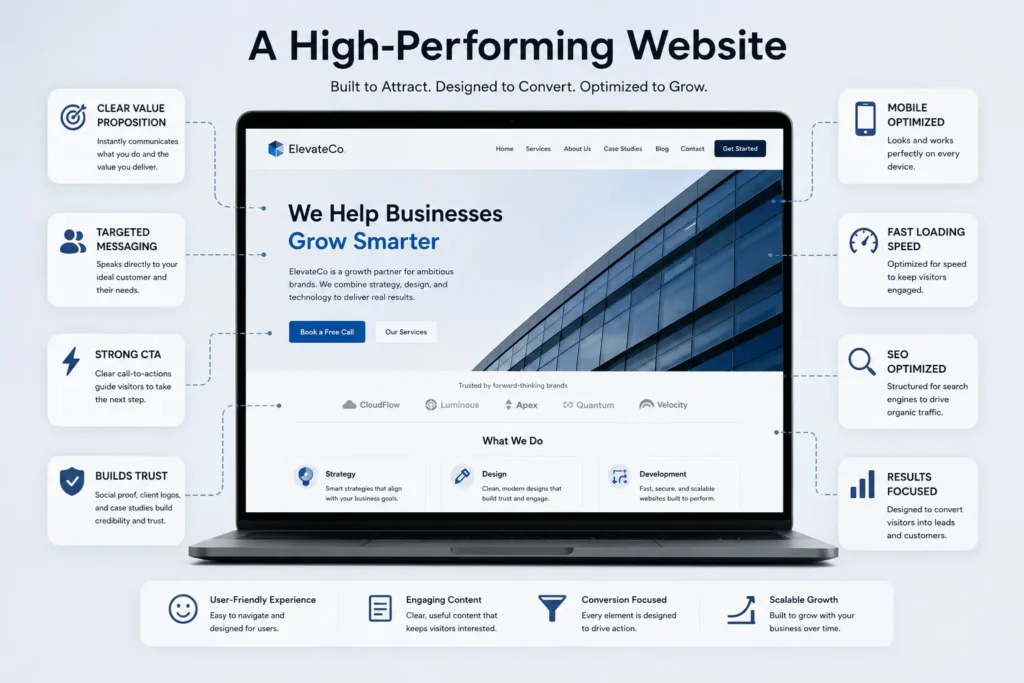
Let’s make this concrete. Here are the characteristics that separate a website that drives business from one that drains it.
Clear Value Proposition Above the Fold
“Above the fold” refers to what a visitor sees before they scroll. You have approximately 3–5 seconds to communicate who you are, what you offer, and why it matters — before a visitor decides whether to stay or leave.
A strong value proposition answers three questions instantly: What do you do? Who do you do it for? Why should they choose you over anyone else?
Most business homepages bury this information. High-performing websites put it front and centre.
Logical User Journey
Every page on your website should have a purpose and a next step. Visitors should never be left wondering what to do. The user journey — from landing on the homepage to becoming a lead — should be intuitive, frictionless, and deliberately structured.
Think of your website like a well-designed physical store. The layout guides you naturally toward what you need, with staff (in this case, copy and CTAs) available at every decision point.
Trust Signals in the Right Places
Trust is earned in milliseconds online. The design, the copy, the social proof, and the technical performance of your website all contribute to whether a visitor trusts you enough to take action.
Effective trust signals include:
- Client testimonials with specific outcomes, not vague praise
- Case studies that demonstrate real results
- Industry certifications or associations
- A clear “About” page that humanises the business
- Visible contact information — phone number, email, address
- SSL certificate (the padlock in the browser bar — non-negotiable for trust and SEO)
Content That Serves the Visitor
High-performing websites don’t just sell — they inform. Service pages that explain not just what you offer but how it works, who it’s for, and what results to expect perform significantly better than thin pages that simply list services with a contact form.
This is where content marketing and website designing intersect. The words on your website are not decorative. They are doing commercial work — educating, persuading, and converting — every hour of every day.
Common Website Mistakes That Are Costing Businesses Right Now
These are the issues we see most consistently when businesses come to Bryeno for a website audit or rebuild.
1. Prioritising aesthetics over function. A beautiful website that doesn’t convert is an expensive mistake. Design should serve the user journey, not the designer’s portfolio.
2. No clear calls-to-action. Visitors shouldn’t have to figure out how to contact you or take the next step. If your CTA isn’t obvious on every key page — you’re losing leads.
3. Ignoring page speed. A site that takes more than 3 seconds to load on mobile loses a large portion of visitors before the page finishes rendering. This is measurable, fixable, and frequently ignored.
4. Building for desktop only. With the majority of traffic coming from mobile, a desktop-first website is a commercially backward decision in 2025.
5. Generic stock photography. Images of people in suits shaking hands or smiling at laptops do nothing for trust. Real photography of your team, your premises, or your work builds credibility that stock images never can.
6. No analytics setup. If you don’t know how many people visit your site, where they come from, what pages they visit, and where they leave — you have no basis for improvement. Google Analytics 4 setup is non-negotiable.
7. Treating the website as finished. A website is not a project with an end date. It’s a living asset that should be tested, updated, and optimised continuously as your business and your audience evolve.
How to Evaluate Whether Your Current Website Is Working
Ask yourself these questions honestly:
- Do you know your website’s current conversion rate?
- Do you know how long visitors spend on your key pages?
- Does your website rank on the first page of Google for your primary services?
- Does your site load in under 3 seconds on mobile?
- Is your value proposition clear within 5 seconds of landing on your homepage?
- Have you updated your website content in the last 6 months?
- Do you receive consistent inbound enquiries from your website?
If you answered no to more than two of these — your website is not performing as a marketing asset. It’s underperforming as a digital brochure.
Why Bryeno Builds Websites Differently
At Bryeno, we approach website development and designing as a business problem, not a creative exercise.
Every website we build starts with your goals — the leads you need, the customers you want to attract, the revenue you’re working toward. From there, we engineer the site structure, design, content, and technical foundation to serve those goals directly.
Our process integrates:
- Strategy — understanding your audience, your competitors, and your conversion goals before a single pixel is designed
- SEO-first development — building for discoverability from the ground up
- Conversion-focused design — every layout decision serves the user journey
- Performance optimisation — fast, mobile-first, Core Web Vitals compliant
- Content alignment — copy that communicates your value and drives action
- Analytics setup — so you can measure what’s working from day one
We also integrate your website with the rest of your digital marketing — SEO, Meta ads, social media, and content — so every channel reinforces the others.
Book a free website strategy consultation with Bryeno — we’ll audit your current site, identify what’s costing you leads, and show you exactly what a high-performing website looks like for your specific business.
Frequently Asked Questions
Q1: How much does professional website development and designing cost for a small business?
Costs vary based on complexity, number of pages, and functionality required. A professionally built business website typically ranges from $2,000 to $15,000+. The more relevant question is: what is your current website costing you in lost leads and conversions? A site that converts 3% more visitors can pay for itself within months.
Q2: How long does it take to build a professional business website?
A well-built business website typically takes 4–10 weeks from strategy to launch, depending on scope. Rushing the process to save time often results in a site that needs expensive fixes within months. A proper build includes discovery, design, development, content, testing, and SEO setup — each phase has a purpose.
Q3: Can’t I just use a website builder like Wix or Squarespace?
For very early-stage businesses or simple personal sites, website builders can serve a short-term purpose. But for businesses serious about ranking on Google, converting visitors, and scaling their online presence — the limitations of template-based builders (performance, SEO control, customisation, load speed) become significant constraints quickly. Most businesses that start on builders outgrow them within 12–18 months.
Q4: What is the difference between web design and web development?
Web design focuses on the visual and user experience layer — layout, typography, colour, imagery, and how the site feels to navigate. Web development is the technical build — the code, functionality, database connections, and systems that make the design work in a browser. The best websites require both disciplines working in close collaboration, not in silos.
Q5: How important is website speed for SEO and conversions?
Extremely. Google’s Core Web Vitals directly factor page speed into search rankings. From a conversion standpoint, slower load times consistently correlate with higher bounce rates and lower conversion rates. A site that loads in 1–2 seconds materially outperforms one that loads in 4–5 seconds on both measures.
Q6: How often should a business update or redesign its website?
Content should be updated continuously — service pages, blog articles, case studies, and testimonials should be refreshed regularly. A full redesign is typically warranted every 3–4 years, or sooner if your business has significantly changed, your site is underperforming, or your design looks dated relative to competitors.
Q7: Does my website need to be integrated with my other marketing channels?
Yes — and this is one of the most underutilised opportunities for small businesses. When your website is aligned with your SEO strategy, your paid ad landing pages, your social media links, and your email marketing — the entire system becomes more efficient. Each channel feeds the others, and your website acts as the central conversion hub for all of them.
Q8: What analytics should I track on my website?
At minimum: total sessions, traffic sources (organic, paid, social, direct), bounce rate, average session duration, pages per session, and conversion rate (form fills, calls, purchases). Google Analytics 4 provides all of this. If you don’t have it set up and configured correctly — you’re making marketing decisions without data.
Conclusion
There is no neutral position. Every day your website underperforms is a day it’s actively costing you — in lost leads, missed rankings, and customers who found a competitor whose site communicated trust and value more effectively.
The businesses that treat their website as a living, strategic marketing asset consistently outperform those that treat it as a one-time expense. They generate more inbound enquiries, convert more traffic, and get more return from every other marketing channel they invest in — because everything eventually leads back to the website.
Professional website development and designing is not a luxury for large businesses. It is the commercial foundation that every serious business needs to compete and grow online.
Your website is ready to become your best salesperson. The question is whether you’re ready to build it that way.
Talk to Bryeno about building a website that works as hard as your business does.