
When you ask a web development agency to build your website or web application, they’ll mention frameworks almost immediately. React. Laravel. Django. Next.js. The list sounds technical, and it’s easy to nod along without actually understanding what’s being decided, or why it matters for your business.
Here’s the thing: the web development framework your agency chooses directly affects how fast your site performs, how securely it handles data, how quickly new features can be added, and how expensive long-term maintenance becomes.
You don’t need to learn to code to understand this. But you do need to understand the basics, because these are business decisions dressed in technical language.
This article explains exactly what a web development framework is, how different types work, which ones are most widely used, and what questions to ask your development team before a single line of code is written.
What Is a Web Development Framework?
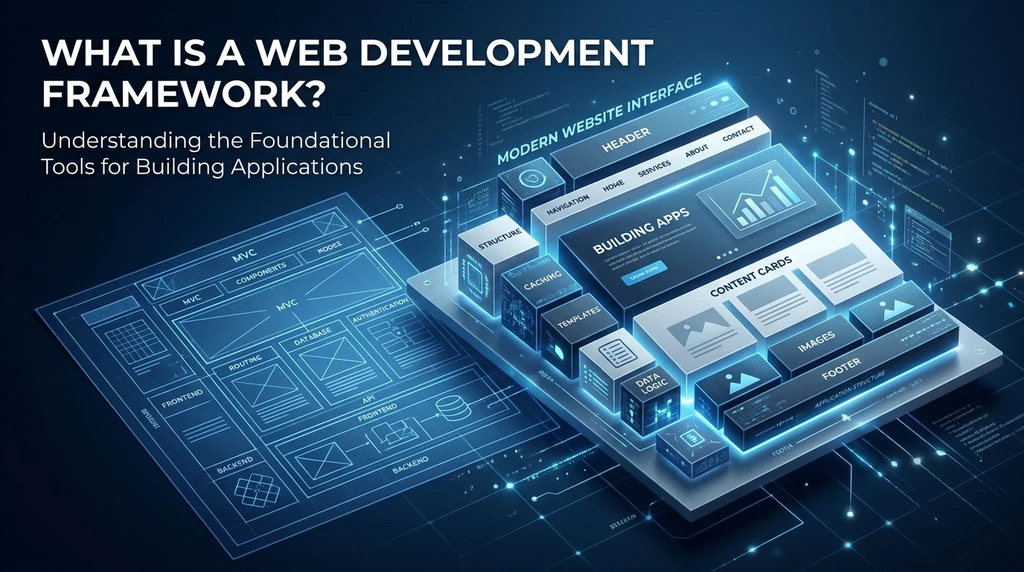
A web development framework is a pre-built collection of code, tools, and rules that developers use as a foundation when building websites or web applications.
Think of it like building a house. You could theoretically manufacture every brick, mix your own concrete, and wire your own electrical system from scratch. But in practice, builders use standardised materials, pre-fabricated components, and established methods, because it’s faster, more reliable, and less prone to structural errors.
A web framework is the equivalent of that standardised building system. Instead of writing every function, security protocol, and database connection from scratch, developers start with a framework that already handles the common, repetitive parts of web development, leaving them free to focus on what makes your specific application unique.
In short: frameworks exist to make web development faster, more consistent, more secure, and easier to maintain.
Why Does the Choice of Framework Matter for Your Business?
Before getting into the types and examples, it’s worth addressing why this decision has commercial consequences, not just technical ones.
Development speed: Frameworks reduce the time it takes to build. Faster builds mean lower development costs and earlier launches.
Security: Established frameworks have built-in protections against common vulnerabilities, SQL injection, cross-site scripting, CSRF attacks. A framework built and maintained by a large community is far more battle-tested than custom code written from scratch.
Scalability: The right framework can handle growth, more users, more data, more features, without requiring a full rebuild. The wrong choice can become a ceiling that forces expensive migration later.
Talent availability: Popular frameworks have large developer communities. If your agency uses a niche or outdated framework, finding developers to maintain or expand your application in future becomes significantly harder and more costly.
Long-term maintenance: Code built on a well-maintained framework stays compatible with modern hosting environments, security standards, and integrations. Frameworks that lose community support become technical debt.
What this means for you: When your agency recommends a framework, they’re making a decision that affects your business for years. Understanding the reasoning behind that recommendation, not just accepting it, is part of being an informed client.
Read: Why Your Website Is Your Most Important Marketing Asset
Frontend vs Backend vs Full Stack: Understanding the Three Layers
To understand web development frameworks, you first need to understand the three layers of a web application.
The Frontend (Client-Side)
The frontend is everything a user sees and interacts with directly, the layout, buttons, menus, animations, and content displayed in the browser. Frontend development is built using HTML, CSS, and JavaScript.
Frontend frameworks help developers build these interfaces faster, with reusable components and consistent behaviour across browsers and devices.
The Backend (Server-Side)
The backend is everything that happens behind the scenes, the server, the database, the logic that processes requests. When you submit a contact form, the backend receives that data, validates it, stores it, and triggers a confirmation email.
Backend frameworks provide the structure for handling these server-side operations, routing requests, managing databases, handling authentication, and building APIs.
Full Stack
Full stack development covers both frontend and backend. Some frameworks, called full stack frameworks, provide tools for both layers in a single, unified environment.
What this means for you: When your developer talks about the “tech stack,” they’re describing the combination of frontend and backend frameworks and languages they’ll use to build your application. Each choice has performance, cost, and compatibility implications.
Types of Web Development Frameworks
Frontend Frameworks
Frontend frameworks, more accurately called JavaScript frameworks or UI frameworks, help developers build the user-facing layer of websites and applications.
React
Developed and maintained by Meta (Facebook), React is currently the most widely used frontend JavaScript framework in the world. It’s technically a library, but functions like a framework in practice.
React uses a component-based architecture, meaning the interface is built from reusable, self-contained pieces. A button, a navigation menu, a product card, each is a component that can be reused across the application. This makes building large, complex interfaces faster and more consistent.
React is the foundation of many high-performance web applications including Facebook, Instagram, Airbnb, and Netflix interfaces.
Vue.js
Vue is a progressive JavaScript framework known for its gentle learning curve and flexibility. It’s popular for projects where the team needs to incrementally adopt a framework rather than commit to it entirely from the start.
Vue is widely used in Asia and has a strong community. It performs well for medium-to-large applications and is particularly valued for its clean, readable code structure.
Angular
Developed by Google, Angular is a comprehensive, opinionated framework, meaning it prescribes a specific way of doing things rather than giving developers flexibility to choose. It’s TypeScript-based and includes everything needed for large-scale enterprise applications out of the box.
Angular has a steeper learning curve than React or Vue but delivers highly structured, maintainable code at scale, making it a common choice for large organisations and complex internal applications.
Next.js
Next.js is built on top of React and adds server-side rendering (SSR) and static site generation (SSG) capabilities. This makes it exceptionally well-suited for websites that need to rank on Google, because search engines receive fully rendered HTML rather than JavaScript that needs to execute first.
For businesses that care about SEO performance, Next.js has become a leading choice in modern web development. [Internal Link: Why Your Website Is Your Most Important Marketing Asset]
Backend Frameworks
Backend frameworks handle the server-side logic, the infrastructure that makes your application function behind what users see.
Laravel (PHP)
Laravel is the most popular PHP web framework and one of the most widely used backend frameworks globally. It provides elegant syntax, built-in authentication, database management tools (called Eloquent ORM), and a robust ecosystem of packages.
Laravel is a strong choice for content-heavy websites, e-commerce platforms, and custom web applications. Its large developer community makes it one of the easiest frameworks to find talent for.
Django (Python)
Django is a high-level Python web framework that follows a “batteries included” philosophy, meaning it ships with almost everything a developer needs built in. Authentication, admin panels, form handling, database management, security protections, all part of the framework from the start.
Django is used by Instagram, Pinterest, and Disqus at scale. It’s particularly valued for rapid development of secure, data-driven applications.
Express.js (Node.js)
Express is a minimal, flexible backend framework built on Node.js, which allows JavaScript to run on the server side. This means developers can use the same language (JavaScript) across both frontend and backend, which simplifies team structure and speeds up development.
Express is lightweight and unopinionated, giving developers significant flexibility. It’s a common choice for building APIs and real-time applications.
Ruby on Rails
Rails is a full-featured backend framework built on the Ruby programming language. It was groundbreaking when launched for its “convention over configuration” approach, reducing decision fatigue and speeding up development by having strong defaults.
Rails is used by GitHub, Shopify, and Basecamp. While less dominant than it once was, it remains a strong choice for startups that need to move quickly.
FastAPI (Python)
FastAPI is a modern Python framework specifically designed for building APIs quickly and with high performance. It’s gained significant traction for applications that need to handle high request volumes and for teams building machine learning or AI-integrated web applications.
Full Stack Frameworks
Full stack frameworks, or meta-frameworks, provide a complete environment covering both frontend and backend in a unified system.
Next.js (covered above) qualifies here too, it handles both the React frontend and server-side rendering logic, and can even function as a lightweight API layer.
Nuxt.js is the Vue equivalent of Next.js, providing server-side rendering and full stack capabilities for Vue-based applications.
Django functions as a full stack framework too when used with Django templates for the frontend layer, making it a complete solution for many web applications without requiring a separate frontend framework.
How Does a Web Development Framework Actually Work?
Here’s a practical illustration.
Imagine you’re building a web application where users can register, log in, browse products, add items to a cart, and complete a purchase.
Without a framework, a developer writes code to:
- Handle routing (deciding which page to show for each URL)
- Manage user sessions and authentication
- Connect to and query the database
- Validate form inputs
- Protect against security vulnerabilities
- Handle errors consistently
- Structure the application’s file and folder organisation
With a framework, all of these are either built in or provided through well-tested packages. The developer implements the logic specific to your business, the product catalogue, the cart behaviour, the payment integration, rather than reinventing infrastructure that’s been solved thousands of times before.
The result: faster development, fewer bugs, more consistent security, and code that other developers can read and maintain, because they already know how the framework is structured.
MVC Architecture: The Pattern Most Frameworks Follow
Most web development frameworks are built around a design pattern called MVC, Model, View, Controller.
Understanding MVC helps you understand how modern web applications are organised.
Model, manages data. This is the part of the application that communicates with the database. The model defines what data exists (products, users, orders) and how it’s stored and retrieved.
View, manages presentation. This is what the user sees, the HTML, the templates, the interface. The view takes data from the model and displays it visually.
Controller, manages logic. The controller sits between the model and the view, processing requests, retrieving data from the model, and deciding which view to render.
A simple example: A user visits your products page. The controller receives that request, asks the model to retrieve all products from the database, and passes that data to the view, which renders the page the user sees.
MVC keeps code organised by separating concerns, data, logic, and presentation are each handled independently. This makes large applications easier to build, test, and maintain.
Comparing Popular Web Development Frameworks
| Framework | Language | Type | Best For |
| React | JavaScript | Frontend | Dynamic UIs, SPAs, large applications |
| Vue.js | JavaScript | Frontend | Progressive adoption, medium applications |
| Angular | TypeScript | Frontend | Enterprise-scale applications |
| Next.js | JavaScript | Full Stack | SEO-focused, server-rendered apps |
| Laravel | PHP | Backend | CMS, e-commerce, custom web apps |
| Django | Python | Backend/Full Stack | Data-driven, rapid development |
| Express.js | JavaScript | Backend | APIs, real-time apps, lightweight servers |
| Ruby on Rails | Ruby | Backend/Full Stack | Startups, rapid prototyping |
This table reflects general industry usage patterns as of 2025. The best choice for your project depends on your specific requirements, your development team’s expertise, and your long-term technical goals.
What Should Business Owners Ask Their Development Agency About Frameworks?
You don’t need to choose the framework, that’s your agency’s job. But you should be asking these questions before sign-off:
1. Why this framework for my specific project?
The answer should reference your project’s requirements, scale, SEO needs, user traffic, budget, timeline, not just the agency’s preference or what they always use.
2. How large is the developer community for this framework?
Smaller communities mean fewer resources, slower security updates, and more difficulty hiring maintenance developers in future.
3. Is this framework actively maintained?
Frameworks go through lifecycle stages. Some become less supported over time. Your agency should be building on technologies with strong, active communities and regular updates.
4. How will this framework affect our SEO performance?
Server-side rendering (Next.js, Nuxt.js, Django) tends to perform better for SEO than purely client-side rendered applications. If organic search matters to your business, and it should, this is a critical question.
5. What does long-term maintenance look like?
Who can work on this codebase in future? How complex is it to add features or make changes? What’s the expected ongoing cost?
[Internal Link: What Does a Digital Marketing Agency Do for Small Businesses?]
The Connection Between Web Frameworks and Business Performance
Here’s something most web development conversations miss: the framework choice has direct implications for your marketing performance, not just your technical performance.
A Next.js or Nuxt.js application with server-side rendering loads faster and delivers fully rendered HTML to search engines, which means better Core Web Vitals scores, better SEO rankings, and more organic traffic.
A poorly chosen framework that produces slow, JavaScript-heavy pages with long load times will be penalised by Google’s ranking algorithm, regardless of how good your SEO content is.
This is why at Bryeno, web development and digital marketing strategy are never separate conversations. The technical decisions made during the build phase have direct consequences for your search visibility, your ad performance, and your conversion rates for years after launch.
[Internal Link: Why Your Website Is Your Most Important Marketing Asset]
How Bryeno Approaches Web Development Framework Selection
At Bryeno, framework selection is a strategic decision, not a default. Every project starts with understanding your business goals, not with a pre-selected tech stack.
We evaluate:
- Your application’s scale and complexity, a marketing website has different requirements than a customer portal or e-commerce platform
- SEO requirements, if organic traffic matters, we build with server-side rendering in mind from day one
- Performance targets, Core Web Vitals compliance is built into our development process, not retrofitted after launch
- Future maintenance, we build on frameworks with strong community support and long-term viability
- Integration requirements, CRMs, payment systems, booking tools, and APIs all influence framework selection
- Your budget and timeline, we match the technical approach to the commercial reality of your project
Our team works across React, Next.js, Laravel, and Django, covering the most robust, widely-supported frameworks available, and we explain our reasoning clearly before a single line of code is written.
Book a free web development consultation with Bryeno, we’ll assess your project requirements and recommend the right technical approach for your specific business goals.
Frequently Asked Questions
Q1: What is a web development framework in simple terms?
A web development framework is a pre-built set of tools, code, and conventions that developers use as a starting point when building websites or web applications. Instead of writing every function from scratch, developers use a framework to handle common tasks, routing, database connections, security, authentication, so they can focus on what makes your specific application unique.
Q2: What is the difference between a framework and a library?
A library is a collection of reusable code that developers call when needed, they stay in control of the application flow. A framework inverts this: the framework is in control, and developers fill in the specific logic within its structure. React is technically a library; Angular is a framework. In practice, the distinction matters less than understanding what the tool does for your project.
Q3: What are the most popular web development frameworks in 2025?
On the frontend, React, Vue.js, Angular, and Next.js are the most widely used. On the backend, Laravel (PHP), Django (Python), Express.js (Node.js), and Ruby on Rails remain dominant. Next.js and Nuxt.js have become leading choices for full stack development due to their SEO and performance advantages.
Q4: Does the choice of framework affect my website’s SEO?
Yes, significantly. Frameworks that use client-side rendering (where JavaScript builds the page in the browser) can create challenges for search engine crawling. Frameworks that use server-side rendering, like Next.js, Nuxt.js, or Django, deliver fully rendered HTML to search engines, which generally produces better indexing and ranking performance.
Q5: How does a web framework improve security?
Established frameworks include built-in protections against common web vulnerabilities, SQL injection, cross-site scripting (XSS), cross-site request forgery (CSRF), and others. They’re tested by large communities and receive regular security updates. Custom-built code without a framework is more likely to have security gaps simply because it hasn’t been battle-tested at the same scale.
Q6: What is MVC architecture in web development?
MVC stands for Model-View-Controller, a design pattern that separates an application into three interconnected layers. The Model manages data and database interactions. The View manages what users see. The Controller manages the logic that connects them. Most major web frameworks are built around MVC or a variation of it, because it keeps code organised and easier to maintain as applications grow.
Q7: What is a full stack web framework?
A full stack framework provides tools for both the frontend (what users see) and the backend (server-side logic and data management) within a single environment. Next.js, Nuxt.js, and Django with templates are examples. Full stack frameworks can reduce complexity for certain projects by keeping the entire application in one technology ecosystem.
Q8: How do I know which web framework is right for my project?
The right framework depends on your project’s scale, your SEO requirements, your team’s expertise, your timeline, and your long-term maintenance needs. A professional development agency should present framework recommendations with clear reasoning tied to your specific business requirements, not simply default to what they always use.
Conclusion
The web development framework your project is built on determines how your website performs in search results, how quickly your team can add new features, how secure your application is, and how expensive it is to maintain over time.
Understanding what a web development framework is, and why the choice matters, puts you in a stronger position as a business owner or decision-maker. You don’t need to pick the framework yourself. But you should understand the reasoning behind the recommendation, ask the right questions, and know what to look for in the answer.
The best development agencies treat framework selection as a strategic conversation. The ones that don’t tend to build on whatever they’re most comfortable with, which may or may not be right for your business.
If you want a development partner that approaches these decisions with your commercial goals in mind, that’s exactly how Bryeno works.
Talk to Bryeno about your web development project, and get a clear, reasoned technical recommendation from day one.